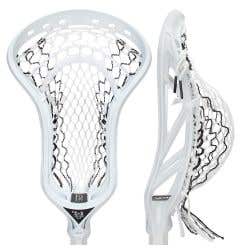
ECD Turbo Mesh Review: The Verdict
If you’re shopping mid-range lacrosse mesh in 2026, this ECD Turbo mesh review is your starting point. It breaks in faster than anything else in this price tier, holds channel through weather, and delivers release consistency that has no business being this affordable.
Who This Is For
Overall, Turbo is built for the serious high school player and the college midfielder who wants shooter-level performance without paying shooter-level prices. Attack players with a refined throwing motion will love it. Defensive poles who string once and forget — they’ll be fine with whatever, but they’re leaving something on the table by not using this. Budget range: $12–$15 per piece depending on where you buy. That’s not a typo. Simply put, this is mid-range pricing doing premium work.
What Works
First, the break-in on Turbo is legitimately one of the fastest we’ve seen from ECD. Most mesh needs a week of wall ball and a few rain sessions before it settles into a consistent channel. Turbo gets there in two or three days of real use. The weave is tight enough to hold its shape but not so stiff that you’re fighting it out of the box.
Meanwhile, weather performance is where Turbo separates itself from the mid-range pack. Rain games are always a gut check for mesh — cheaper options balloon out and turn your pocket into a soup bowl. Turbo absorbs moisture without losing its shape. The channel stays defined, the release point stays predictable, and you don’t have to re-string after a wet weekend tournament.
Finally, release consistency is the real selling point here. Turbo has a clean, repeatable feel on every throw. The ball comes off the same way whether you’re feeding on the crease or throwing X to X. That kind of consistency is what separates mid-range mesh from budget mesh, and Turbo nails it.
What Doesn’t
However, Turbo is not ECD Hero. If you’ve thrown with Hero 3.0 and you’re expecting that same buttery, dialed-in feel, manage your expectations. Hero has a softer hand feel and a slightly more forgiving pocket depth — it’s a more polished product at a higher price, and you can tell. Turbo’s weave is a touch stiffer even after break-in. Attackmen who like a very soft, deep pocket will spend more time working it than they would with Hero.
The color options are also underwhelming. ECD offers Turbo in the basics. If you’re building an aesthetic with your stringing job, you’ll find the selection thin compared to StringKing Type 4, which comes in seemingly every color combination known to man.
One more honest note: Turbo doesn’t hold up quite as well as Type 4 over the long haul. After a full season of heavy use, Type 4’s structural integrity holds better. Still, Turbo starts to loosen up around the channels faster than StringKing’s competition piece. It’s not a dealbreaker for most players, but it’s worth knowing if you string once and play for twelve months without touching it.
Price vs. Value
At $12–$15, Turbo is aggressive value. Hero runs closer to $20, and Type 4 sits in the same $12–$15 range as direct competition. Turbo versus Type 4 is the real fight here, and it’s closer than ECD fans want to admit. Type 4 edges out Turbo on durability and color variety. Turbo edges out Type 4 on break-in speed and weather performance. If you’re in a rainy climate or you want a new mesh that performs immediately, buy Turbo. If you want something that lasts a full year without re-stringing and you care about color matching your lid, buy Type 4.
Against Hero, the gap is clearer. Hero is worth the extra $5–$8 if you’re a high-level attack player who lives and dies by release feel. For everyone else, Turbo gives you 85% of the Hero experience at 65% of the cost.
Bottom Line
Overall, ECD Turbo mesh is the real deal for mid-range buyers. Fast break-in, solid weather performance, and release consistency that matches products in a higher price tier. It’s not going to replace Hero for the finesse players who need that top-shelf feel, and StringKing Type 4 still wins on longevity. But as an everyday stringing choice for the serious high school player or the college athlete watching their equipment budget — Turbo is the move. Buy it, string it, and stop overthinking your pocket setup.