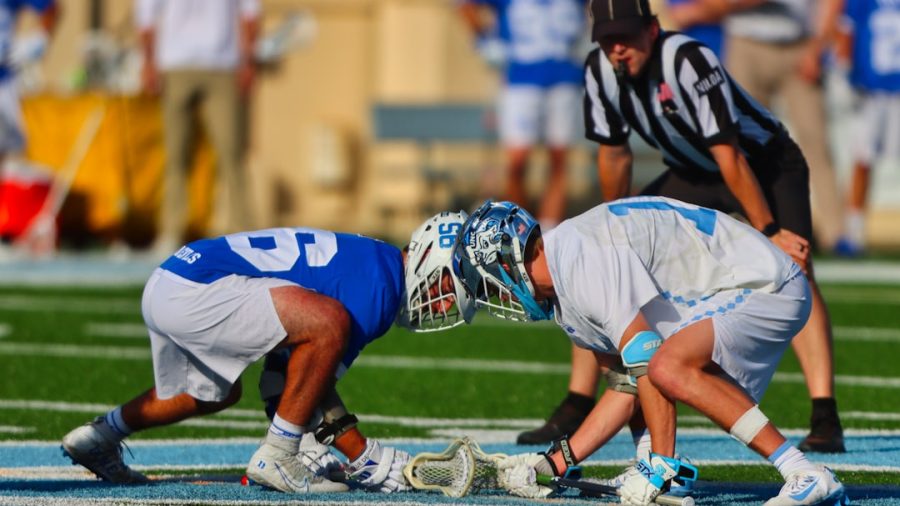
The best offenses in college lacrosse don’t win because they have the fastest dodger or the most accurate shooter. They win because every player on the field is moving with purpose, reading the defense, and forcing defenders to make impossible choices. Off-ball movement is the engine of championship-caliber D1 offense — and most programs still don’t run it well enough.
The Problem With Ball-Dominant Offense
Here’s the truth about most D1 offenses: they’re lazy. The ball carrier goes one-on-one, everyone else stands and watches, and the defense collapses with zero consequences because nobody is cutting, nobody is setting picks, and nobody is making the off-ball reads that actually stress a defense. Five-on-five lacrosse becomes one-on-one lacrosse with four spectators. Championship programs don’t play that way.
When Maryland, Notre Dame, or Duke is running on all cylinders, you’re watching six players operating like one organism. The ball carrier’s dodge creates movement everywhere — cutters reading the slide, backside attackmen relocating, middies hitting spots before the ball gets there. That’s not chemistry. That’s a system executed at a high level.
Pick-and-Roll: Lacrosse’s Most Underused Weapon
Basketball figured this out decades ago. Lacrosse is still catching up. The pick-and-roll — or more precisely, the pick-and-cut in lacrosse terms — is one of the most devastating tools in an offensive coordinator’s playbook when it’s actually run correctly.
The concept is straightforward: an off-ball player sets a screen on a defender, forcing a coverage decision. Does the defense switch? Fight through? Help over? Every option creates an advantage somewhere. If they switch, you likely have a mismatch. If they fight through, the cutter gets a step. If they help, the ball carrier has a lane or a skip pass opens up on the weak side.
The execution is where teams separate themselves. A pick set in the wrong spot — too far from the ball, wrong angle, bad timing — is just traffic. A pick set at the right moment, reading where the defense is shaded, forces a genuine decision. The screener also has to be ready to roll or fade based on the defensive reaction. This isn’t just the cutter’s job. It’s a two-man action that requires both players reading the same thing simultaneously.
Cutting Sequences That Actually Work
The classic V-cut is everywhere at the D1 level because it works — but only if the defender is playing honest. The cutter sells the cut away, plants hard, and cuts back to the ball. Simple. Effective against man coverage. But defenses have seen it a thousand times, and if the defender is sitting on the cut-back, you need a counter.
The read-and-react layer is what separates elite programs. If the defender jumps the V-cut back, the cutter keeps going backdoor. If the defender sags off, the cutter pops out for a catch-and-shoot. These aren’t plays called from the sideline — they’re reads made in real time by two players who have put in enough work together that they’re speaking the same language without words.
Backside cutting is criminally underused. When the ball is on one side of the field and a defender is ball-watching, the backside attacker has three or four steps of free space. The best teams in the country — look at Virginia’s offense in their championship runs — exploit backside cuts ruthlessly. One cutter occupies the crease, another times a backside diagonal, and suddenly a team that was set defensively is scrambling to find a cross-crease skip.
The Reading Skills That Make It All Work
None of this functions if players don’t understand what they’re reading. Off-ball players need to be scanning constantly: Where is my defender’s head? Is he watching the ball? Is he cheating toward the crease? Is the slide coming from my side or the other?
Lacrosse is a game of angles and gaps. The split-second a defender turns his hips toward the ball is the split-second a backside cutter should be on the move. The ball carrier’s job is to manipulate the defense with his dodge or shot threat — the off-ball players’ job is to recognize what that manipulation has created and attack it immediately.
This is what’s meant when coaches talk about “IQ.” It’s not some abstract quality. It’s pattern recognition built through repetition — thousands of reps of reading defense reactions and making the right play with the time and space you’re given.
Why Championship Offenses Are Built Off the Ball
The final piece is the willingness to be selfless. Picking for a teammate who gets the goal isn’t glamorous. Cutting hard through traffic without touching the ball isn’t going to end up in a highlight reel. But those are the plays that make the highlight-reel goals possible. The assist on the goal is visible. The cut that pulled a defender out of position two possessions earlier is invisible — and often more important.
Programs that win multiple championships — Maryland, Virginia, Syracuse in their eras — have always prioritized team offense over individual creation. That’s not a coincidence. Off-ball movement is the difference between an offense that scores when it has talent advantages and an offense that scores even when the talent is equal. That’s what wins in March and April when the talent gap between teams is smallest and execution matters most.