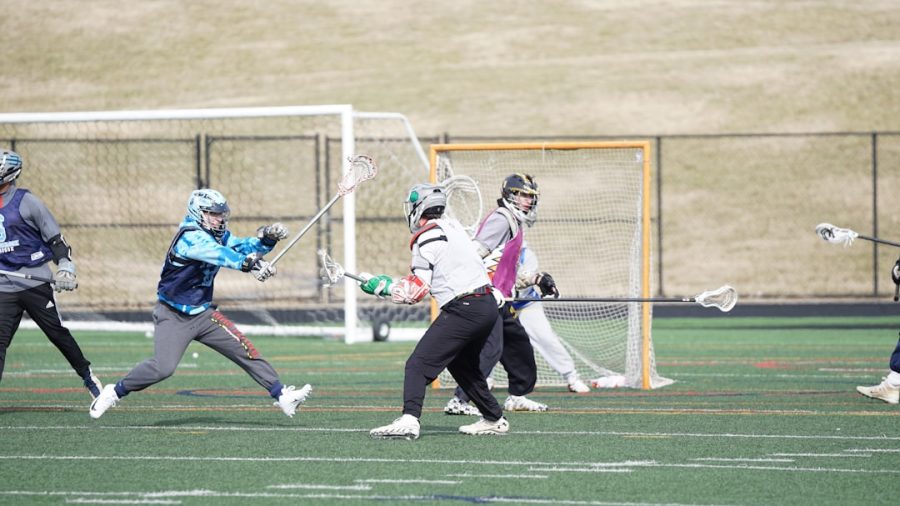
You watched Charlotte North, Izzy Scane, and Alex Aust Holman tear apart college lacrosse for years. Now they’re playing professionally in the WLL, and the game looks a little different. Six players per side instead of twelve. A smaller field. Faster possessions, higher scores, more chaos. If you’re a women’s college lacrosse fan trying to understand what you’re watching, here’s your guide to Lacrosse Sixes — the format built for the next era of the sport.
What Is Lacrosse Sixes?
Lacrosse Sixes is a modified version of field lacrosse designed for fast play and compact spaces. The most obvious change: six players per side instead of ten (field lacrosse) or twelve (women’s college). You get a goalie plus five field players, and everyone is expected to contribute on both ends. There’s no hiding a weak defender behind a packed midfield. Everyone touches the ball. Everyone runs.
The field is smaller than a regulation field lacrosse surface, which compresses decision-making and opens up space differently than the full game. Possessions move fast. Transition happens constantly. If traditional field lacrosse rewards the team that controls tempo, Sixes rewards the team that handles pressure.
How Did the WLL End Up With This Format?
The WLL — Women’s Lacrosse League — was announced in November 2024 by PLL President Paul Rabil on ESPN’s Get Up. The league is a wholly owned PLL subsidiary, and when they were building it, the format choice wasn’t arbitrary. Lacrosse Sixes is the format that the International Olympic Committee selected for the 2028 Los Angeles Olympics. That’s the whole ballgame, right there.
When lacrosse returns to the Olympic program in 2028 — the sport’s first Olympics appearance since 1908 — it’s going to be played in this format. That means every WLL game is effectively an extended audition for Team USA rosters. The players know it. The league knows it. And now you know it too.
The Key Differences From Women’s College Lacrosse
If you’re coming from NCAA women’s lacrosse, here’s what’s going to look different immediately:
Fewer players, more space per player. Six-on-six means the field opens up in ways you don’t see in the college game. Dodges that would get shut down by help defense in a 12v12 setting become live plays. Every defender has to guard actual space.
Higher-scoring games. The WLL’s inaugural Championship Series in February 2025 finished with the Boston Guard beating the New York Charging 22-17 in the final. That kind of output reflects the format — possessions are shorter, transition opportunities are more frequent, and goalies are under constant pressure.
Possession pressure. Sixes is designed to keep the ball moving. There is no camping the crease and eating time. You attack or you turn it over.
Roles are blended. In the college game, you mostly know who the attackers are and who the defenders are. In Sixes, everyone transitions. A player like Izzy Scane — the all-time NCAA scoring record holder at Northwestern and the New York Charging’s captain — isn’t standing at the crease waiting for a feed. She’s running.
The Teams and Who to Watch
The WLL launched with four teams: the Boston Guard (captain Charlotte North), the California Palms (captain Ally Mastroianni), the Maryland Charm (captain Alex Aust Holman), and the New York Charging (captain Izzy Scane). The captains alone read like an NCAA All-Decade team. This isn’t a developmental league. The best women’s lacrosse players in the world are in this competition.
Boston won the first championship in 2025, when the league ran a single Championship Series weekend in Springfield, Virginia. In 2026, the WLL expanded to a full season with playoffs for the first time. That’s the trajectory: from a weekend showcase to a proper competitive calendar, with the Olympics on the horizon.
Why This Format Is Good for the Game
Here’s the honest take: Lacrosse Sixes isn’t a compromise. It isn’t a lesser version of lacrosse that the IOC accepted because it fit on a smaller venue floor plan. It’s a genuinely exciting product that highlights individual skill in ways the full game occasionally buries under team systems. When there are only five field players on your side, there is nowhere to hide talent and nowhere to hide weakness.
The WLL’s decision to build around this format wasn’t just a strategic bet on Olympic relevance — it was a bet that the format itself would showcase the athletes. So far, that bet is looking correct. The players who built their reputations in the college game are thriving under it. The format is fast, the scores are real, and the best players in women’s lacrosse are treating it seriously because it leads somewhere that matters.
Los Angeles is three years away. The WLL is already there.