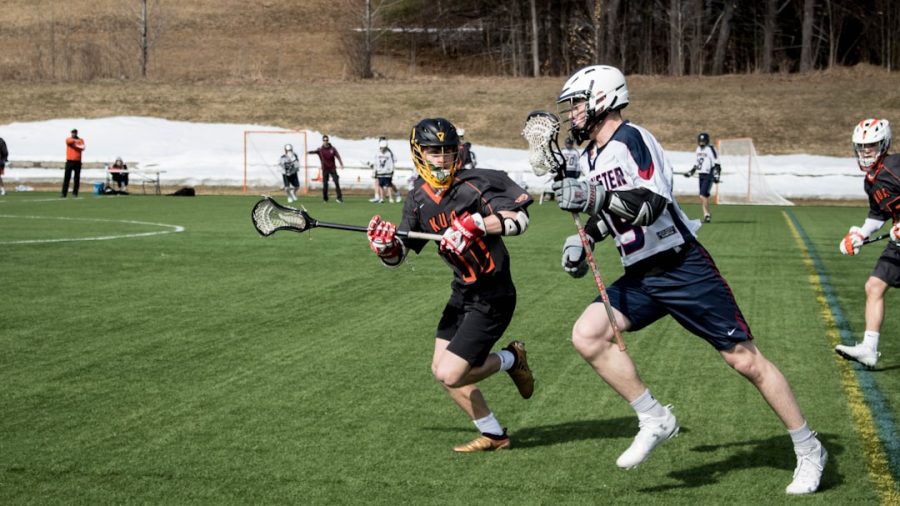
If you’re playing long pole, your shaft is your weapon. A bad defensive shaft doesn’t just hurt your game — it gets exploited. Attackmen study your grip, your checking mechanics, your recovery angle. The wrong 60-inch pole makes all of that harder. The right one disappears into your hands and lets you just play defense.
We ranked the best defensive shafts on the market in 2026 based on what actually matters for long-pole play: weight for outlet passes and transition, durability under repeated checks and slashes, grip texture for wet conditions and glove-heavy weather, and how well the shaft holds up to the physical punishment that defines defensive play. Price matters too — a $200 shaft that cracks in one season is a worse value than an $80 shaft that lasts three years.
How We Ranked These
Defensive shafts get evaluated differently than attack or midfield handles. We weighted durability and check resistance above all else, followed by weight (lighter is better for transition, but not at the expense of stiffness under contact), grip quality in multiple conditions, and value relative to price. We’re not ranking based on what pros are using in their Instagram content — we’re ranking based on what holds up over a full season of defensive play at every level from high school to club to collegiate.
1. Epoch Dragonfly Elite — Defense (60″)
The best defensive shaft you can buy right now, full stop. Epoch’s carbon composite construction gives you a shaft that weighs around 135 grams while taking checks that would dent or crack aluminum. The texture is aggressive enough to hold through wet gloves without being abrasive on bare hands, and the stiffness profile is tuned specifically for defensive mechanics — it doesn’t whip on checks. At roughly $180, it’s expensive, but it’s the shaft that doesn’t need replacing. Built for serious high school players, college players, and competitive club. If you’re going halfway on a defensive shaft, go elsewhere.
2. STX Surgeon 700 Scandium (60″)
Scandium alloy at a better price point than full carbon, and the Surgeon 700 proves you don’t have to spend Epoch money to get a legitimate defensive shaft. It comes in around $100–$120 and delivers the rigidity you need for physical play. The grip texture is slightly smoother than the Dragonfly, which some defenders prefer — less friction on re-grips mid-play. Durability is excellent for a metal shaft. This is the shaft for the high school or college player who wants pro-grade performance without the premium price tag. It’s not second place by much.
3. Maverik Hyperlite 2 Defense (60″)
Maverik continues to quietly produce excellent gear without getting the hype it deserves. The Hyperlite 2 Defense is a carbon shaft that sits in the $140–$160 range and competes directly with the Epoch in terms of weight — it’s actually slightly lighter on some measurements. Where it gives a little back is in grip texture, which is more moderate. For defenders who prioritize weight and transition speed over raw check durability, this is the shaft. Great fit for athletic, transition-heavy defenders at the high school and collegiate club level.
4. Warrior Burn Warp Pro Defense (60″)
The Burn Warp Pro is Warrior’s answer to the carbon shaft market and it holds its own. Priced around $130, it’s a legitimate option that most players aren’t giving enough credit to. The shaft has a slightly thicker grip profile than competitors, which some bigger-handed defenders genuinely prefer — better leverage on defensive clamps and body checks. Durability is strong. It’s not quite as refined as the Epoch or STX at the top, but it’s closer than the price gap suggests. Worth serious consideration for high school varsity defenders and box crossover players.
5. East Coast Dyes Carbon Pro Defense (60″)
ECD’s Carbon Pro Defense sits around $120 and is the most underrated shaft on this list. The carbon construction is legit, the weight is competitive, and the grip texture is excellent for a shaft in this price tier. The knock on ECD shafts has traditionally been consistency — not every unit feels identical — but the Carbon Pro Defense has cleaned that up considerably. If you want a carbon shaft and don’t want to pay Epoch prices, this and the Maverik are your two best bets. Built for high school through competitive club.
6. Nike CEO Defense (60″)
The Nike CEO Defense is a solid alloy shaft that belongs on this list for one reason: it’s around $60–$75 and it doesn’t embarrass itself. For a younger player, a JV defender, or someone who breaks or loses shafts regularly enough that spending $150+ feels unreasonable, this is the answer. It’s heavier than the carbon options and will dent if you’re playing physical enough lacrosse, but for recreational and entry-level high school play it does the job. Don’t buy this if you’re playing serious varsity or college ball — buy it if you need a reliable shaft that won’t hurt when it gets lost in the equipment pile.
7. Brine King Superlight Defense (60″)
Brine doesn’t move units the way it used to, but the King Superlight Defense is a capable alloy shaft in the $70–$90 range. Heavier than carbon, obviously, but it handles checks well and the grip is above average for metal. It’s a step down from the Nike CEO in terms of brand investment and probably a step up in quality. If you’re buying for a youth player who’s growing into defensive play and you’re not ready to commit to a carbon shaft, the King Superlight is a reasonable call. It’s not exciting, but it works.
The Bottom Line
Serious varsity or college defenders: start at the Epoch Dragonfly Elite and work down based on budget. The STX Surgeon 700 is the best value play in the field — it’s not going to lose to the Epoch in most situations and it costs $60 less. The Maverik Hyperlite 2 is the right call if your game is transition-first and you want the lightest possible shaft.
High school players who are still developing physically: the Warrior Burn Warp Pro and ECD Carbon Pro Defense are both legitimate options in the $120–$140 range. You’re not leaving anything significant on the table at that level.
Youth and recreational players: the Nike CEO Defense or Brine King Superlight do what you need them to do at a price that makes sense. Save the carbon shaft money for when you’re sure this is the position and the commitment level.
The defensive shaft market is better than it’s ever been. There’s no excuse for playing with a pole that fights you.