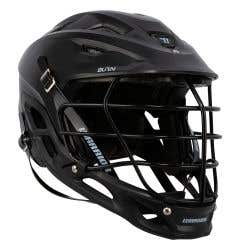
Every lacrosse helmet sold in the United States carries a NOCSAE stamp. Most players glance at it, assume it means something important, and move on. Here’s the thing — it does mean something important. But it doesn’t mean what most people think it means, and the gap between “certified” and “actually good” is wide enough to drive a truck through.
Let’s break this down in plain language, because the equipment industry has no incentive to explain it clearly.
What NOCSAE Actually Is
NOCSAE stands for the National Operating Committee on Standards for Athletic Equipment. It’s an independent nonprofit that sets performance standards for helmets, balls, and other sports protective gear. They’re not a government agency, and they don’t manufacture anything. They set the bar, and manufacturers test against it.
For lacrosse helmets, NOCSAE certification means the helmet passed a standardized impact test — specifically, the helmet was dropped onto a rigid surface from set heights at set temperatures, and the force transmitted to a test headform stayed below a threshold called the Severity Index. Pass that, and you get the stamp. Fail it, and you don’t go to market.
That’s it. That’s the certification. It’s a minimum floor, not a quality ceiling.
What the Standard Doesn’t Cover
Here’s where people get confused, and where the lacrosse industry has been quietly benefiting from that confusion for years.
NOCSAE certification does not mean a helmet is optimized for the specific impact patterns of lacrosse. The test protocol uses drop impacts onto a flat surface. A lacrosse shot is an oblique impact — the ball hits at an angle, generating rotational forces on the brain. Rotational acceleration is increasingly understood as a primary driver of concussion. The NOCSAE drop test doesn’t directly measure it.
Certification also doesn’t account for fit. A NOCSAE-certified helmet that doesn’t fit properly is significantly less protective than the same helmet properly fitted. The standard tests a helmet on a standard headform, not on your head. Sizing, padding compression over time, and proper chin strap adjustment all affect real-world protection — and none of that shows up in the certification process.
Finally, NOCSAE doesn’t tell you anything about durability over time. A helmet that passes on day one might degrade significantly after two seasons of sun exposure, sweat, and hits. There’s no recertification requirement.
Why Some Certified Helmets Are Better Than Others
The market has three tiers of lacrosse helmets: entry-level ($80–$150), mid-range ($150–$250), and premium ($250–$400+). Every tier gets the same NOCSAE stamp. The stamp doesn’t tell you which tier you’re buying.
What separates a Cascade XRS from a no-name helmet that also carries the certification comes down to margin above the floor. Premium helmets are engineered to exceed the NOCSAE standard, not just clear it. Better foam technology (multi-density liners, D3O inserts, MIPS-adjacent rotational systems), more precise fit systems, better ventilation that keeps foam performing in heat, and more rigorous internal testing all contribute to a helmet that sits further from the failure threshold.
Virginia Tech’s Helmet Lab publishes independent ratings for lacrosse helmets using a more comprehensive testing methodology than NOCSAE minimum standards. Their star ratings actually differentiate between helmets that barely pass and helmets engineered well above the floor. If you want a real performance signal, that’s where to look — not at the NOCSAE stamp that every helmet has anyway.
What This Means for You
If you’re outfitting a youth player or buying on a tight budget, NOCSAE certification tells you the helmet isn’t dangerous. That’s genuinely useful. A certified helmet is meaningfully safer than no helmet, and it’s safer than anything that couldn’t clear the standard.
If you’re a high school or college player taking real shots from real stick speeds, treat NOCSAE as the entry ticket — not the destination. The difference between a helmet that barely passes and one built to exceed the standard is real, and that difference compounds over a season of contact.
The industry will tell you their helmet is certified. Ask what it scores on Virginia Tech’s scale. That’s a harder question, and the answer tells you more.
NOCSAE does important work. The standard exists for good reasons, and helmets that don’t meet it are rightfully kept off the field. But “certified” is the floor of acceptable, not proof of excellence. Know the difference before you buy.