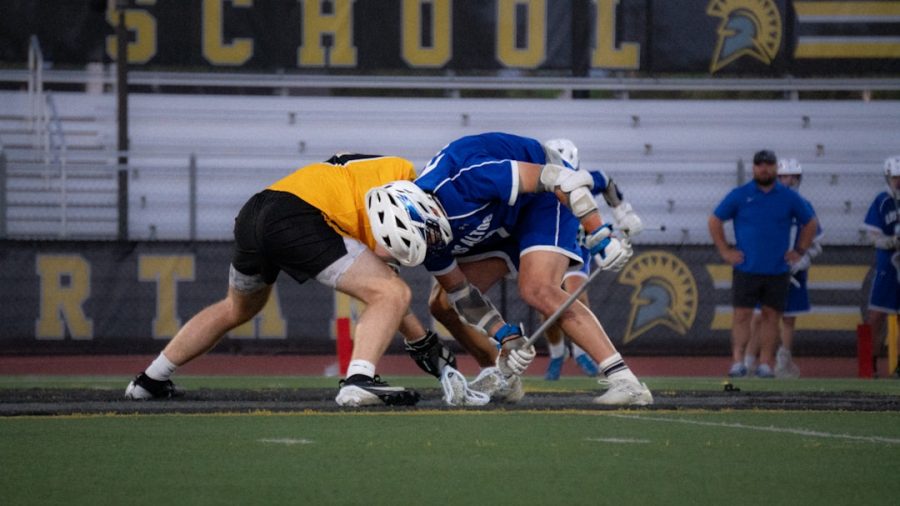
Every faceoff specialist knows the dirty secret of the draw circle: the whistle is almost irrelevant. By the time the official blows, the battle is already decided. The guy who wins at the collegiate level wins it in film study, in the weight room, and in thousands of reps on the practice field — not in the three seconds after the ref says “set.”
Here’s what that actually looks like at the D1 level, and why the faceoff position has evolved from an afterthought into a genuine game-changer.
Stance: The Foundation Everything Else Builds On
There is no single “correct” stance, and any FO specialist telling you otherwise is either lying or hasn’t faced enough elite competition. What works is what’s repeatable under pressure. That said, the two dominant setups at the high major level are the motorcycle and the clamp, and they each demand different lower-body positioning.
The motorcycle grip puts both hands in an overhand position, wrists rotated inward — think choking a motorcycle throttle. It’s built for speed and explosion. The footwork that pairs with it typically features a narrow base, weight loaded forward on the balls of the feet, rear foot angled for lateral drive. Players like Connor Martin made careers out of this setup because the initial burst is nearly impossible to time defensively.
The clamp is more about control than initial speed. The top hand drives down on the ball while the bottom hand levers the shaft for pinch. Wider stance, lower center of gravity, weight more evenly distributed. Elite clamp guys don’t try to blow their opponent up off the line — they try to suffocate the ball and kill the possession before the opponent can react.
The underrated element in both setups: head position. Your eyes should be locked on the center of the ball, not your opponent’s stick. Watching his hands or his eyes is a trap — you’ll react to his movement rather than the ball, and at D1 speed, that half-beat is the game.
Grip Tech: Hand Placement Is Not Negotiable
The hands tell the full story of what an FO specialist is trying to accomplish. Sloppy grip means sloppy faceoffs, full stop.
For the motorcycle, hand placement has gotten extremely precise at the elite level. The bottom hand sits roughly six to eight inches from the head. Too close and you lose leverage; too far and your initial clamp loses strength. The top hand needs to be tight enough to control the stick through the explosion phase but not so tight that it slows your reaction time.
Thumb positioning matters more than most coaches teach. A thumb angled toward the head creates natural torque on the clamp. Thumb angled back toward the butt end opens up the sweep and trail series — moves that are most effective when your initial clamp gets read by an opponent who’s seen your film.
The best FO guys in the country are constantly tweaking grip width and angle based on the matchup. They’re not running the same hands every rep. They’re making micro-adjustments based on what they saw on film from Tuesday.
The Read-and-React Game: Film Work Is the Real Work
Here’s where the truly elite separate from the merely good: the mental preparation that happens before Saturday.
Every D1 faceoff specialist at a program that takes the position seriously is watching film of their upcoming opponent the same way a quarterback studies a defensive coordinator. What’s his initial move off the whistle — clamp, rake, or motorcycle? Does he cheat his stance to his dominant side? What does he do when he’s down 0-2 in the faceoff battle — does he switch techniques or dig in? How does he respond to a counter move versus an initial attack?
Read-and-react training operationalizes that film work. The best FO coaches in the country — and yes, there are now FO-specific coaches at major programs — run their guys through scenario drilling, not just straight technique reps. Call “motorcycle counter” and your guy should be executing the muscle memory before his brain finishes processing the word. That’s the standard.
The mental side extends to pre-snap positioning too. Where you set up your feet relative to the center line, how you place your stick head, whether you make eye contact with the ref or stare at the ball — all of it is information you’re sending your opponent. Elite FO guys weaponize this. They show one set-up in warmups and run a different one in the third quarter when the game is on the line.
What Makes a D1 Elite FO Specialist
The position has become specialized enough that programs are now actively recruiting it the way they recruit goalies — as a standalone skillset that justifies a scholarship even if the player’s field game is limited. Maryland, Virginia, Duke, Notre Dame — they’re not winning faceoff battles by accident. They’ve invested in the position.
The physical markers are obvious: explosive hip flexion, strong forearms, quick-twitch hands. But the differentiators at the elite level are the traits you can’t measure on an athletic testing sheet. Competitive IQ — reading an opponent mid-faceoff and switching techniques in real time — is either there or it isn’t. Pressure performance, the ability to go 4-for-4 when the game is tied in the fourth quarter, separates guys who are “good in practice” from guys who actually change outcomes.
Clearing ability matters too, more than it used to. A specialist who wins 65% of faceoffs but loses the ball on the clear is leaving goals on the field. The modern FO specialist at the D1 level is expected to win the draw AND make the initial read to get the ball moving up the field. Half the job is the faceoff. The other half is what happens in the next four seconds.
The Bottom Line
Faceoffs look like a coin flip to casual fans. They are not. They are the most technically demanding individual position in the sport, and the teams that treat them that way are the teams that win extra possessions every single game. Extra possessions turn into extra goals. Extra goals win championships.
The guy who dominates the draw circle on Saturday started winning that battle last Tuesday on film. Remember that the next time someone tells you faceoffs are just about who’s faster off the whistle.