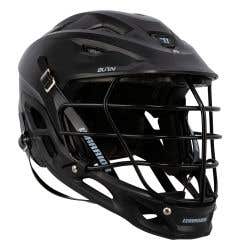
Attackmen live and die by their vision. You’re dodging from X, reading the crease, threading passes through traffic — a helmet that kills your sightlines or weighs down your neck is actively working against you. This isn’t a position where you buy the helmet your defenseman uses. This guide is specifically for attack players who need lightweight construction, wide field-of-view facemasks, and sideplate configurations that don’t turn your peripheral vision into a guessing game.
How We Ranked These
Rankings are based on four factors weighted for attack play: sightline quality (facemask and sideplate combination), overall weight, range of motion during dodging and shooting mechanics, and fit/retention at high speed. Price matters too — we’ll tell you exactly who each helmet is built for and whether the cost is justified.
1. Cascade XRS Pro
The XRS Pro is the benchmark for attack-position helmets and it’s not particularly close. The Vision Pro Plus facemask option opens up the top of your sightline dramatically, and the sideplate design is slim enough that off-ball vision — the thing that separates good attackmen from elite ones — is actually usable. Runs $400-$450. This is for the high school senior committed to a D1 program and the college player who treats gear as an investment, not an expense.
2. Cascade CS-R
Lighter than the XRS Pro and built with attack players specifically in mind, the CS-R gives up a marginal amount of protection in exchange for a weight reduction that you will actually feel over a two-hour practice. The fit system is excellent — it locks down without the helmet shifting during contact, which matters when you’re absorbing a check while trying to finish. Street price is $280-$320. This is the best value option at the high school varsity level.
3. Cascade CPX-R
The CPX-R is a workhorse that’s been the standard for years for good reason. It’s not the lightest and it’s not the most advanced, but the facemask options are broad, it fits a wide range of head shapes reliably, and at $200-$250 it’s accessible without being a compromise. Serious club and varsity players who want proven performance without spending XRS Pro money should be looking here. Do not cheap out further than this — anything in the sub-$150 range is false economy.
4. STX Stallion 700
STX built the Stallion 700 as a genuine challenger to Cascade’s dominance, and for attack players specifically, the wide-vision facemask configuration is worth taking seriously. The sideplate design was clearly developed with offensive players in mind — the cutouts are positioned where they actually help you see off-ball cuts rather than just looking sleek in product photos. Priced around $260-$300. If you’ve never fit well in Cascade shells, try this before you give up on finding a helmet that works for your head shape.
5. Maverik Rome RX3
Budget entry that doesn’t completely embarrass itself. The Rome RX3 lands around $150-$180 and it satisfies certification requirements, which is the minimum bar. For a youth player just getting serious about the position, or a high school JV player whose parents aren’t ready to spend $300 on a sophomore, this is the honest answer. It’s heavier than everything above it and the sightlines are average. But it’s fine for developmental level play, and “fine” is actually the right word here — don’t use it if you’re competing at a level where gear matters.
The Bottom Line
If you’re playing D1 college lacrosse or serious club ball and attack is your position, buy the Cascade XRS Pro. Full stop. The sightline advantage over everything below it is real and it shows up in game situations. If that price point isn’t realistic, the CS-R at $280-$320 is the right call — it was built for exactly this use case. The CPX-R and STX Stallion 700 are both legitimate options for high school players who want quality without paying premium prices. The Rome RX3 is for youth and developmental players only.
One more thing: don’t let anyone talk you into buying a defenseman’s helmet because “a helmet is a helmet.” Protection profiles, weight distribution, and sightline engineering differ by position. Attack players need to see the whole field, all the time. Buy accordingly.